The What: Relationship Management Systems in Practice
Feb 13, 2026
Introduction
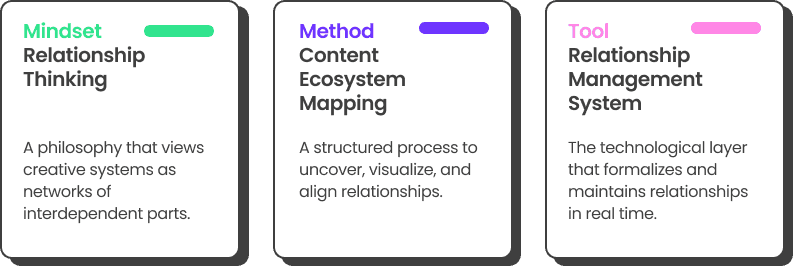
You’ve diagnosed the problem (content chaos). You’ve embraced the philosophy (Systems Thinking). Now, how do you operationalize it?
Enter Relationship Management Systems (RMS), the missing layer between your creative vision and your technical pipeline.
What is an RMS?
At its core, a Relationship Management System is an evolution of the classic Content Management System (CMS). Where a CMS stores and organizes discrete pieces of data (like text, images, or structured entries), an RMS focuses on the relationships between those pieces.
In a CMS, a quest might simply have fields for title, description, and objective text. In an RMS, the quest doesn’t just store data; it links dynamically to the characters, locations, and items it references. If the character’s name changes or the weapon’s attributes evolve, the quest updates automatically. This creates a network of dependencies that stays synchronized across the entire project.
The Core Principles of an RMS
Separation of Content and Presentation
An RMS decouples your content layer from your presentation layer.
The same data that powers a Unity game could also serve a web-based editor, analytics tool, or dialogue visualizer. You can change the text, attributes, or structure without ever touching the game code.Dynamic Relationships
Every object in the system, whether it’s a quest, character, dialogue, or item, can reference others. These links form a dynamic network that keeps all dependencies in sync.Type Safety and Consistency
Relationships aren’t just strings or IDs. They’re typed references that follow template definitions. If a “Character” template gains a new attribute (say, “alignment” or “voice actor”), all related data updates automatically.Automatic Detection and Linking
Documents, design notes, and scripts are scanned for known objects or tags. If someone writes about a location or character that exists in the system, those references become live connections.Versioning and Ownership
RMS systems track who changed what and when. Every update has a version history, ensuring that large teams can collaborate without losing track of evolving content.Localization Awareness
Because text relationships are explicit, translations can stay synchronized automatically. When a line changes, every language version updates its key, without breaking the structure.
The Culture: From Silos to Shared Understanding
The biggest barrier to adoption isn’t technical, it’s cultural. Studios thrive when:
Designers act as system architects, not just Excel wizards.
Writers own data structure, not just prose.
Engineers build bridges, not bottlenecks.
The Role of the Relationship Architect
This emerging discipline sits at the intersection of creative and technical teams. Their job? Design the invisible connections that make collaboration frictionless.
Think about this: Who in your team is the Relationship Architect right now? How do they keep track of the content ecosystem?
Getting started
Map One Ecosystem:
Pick a small system (e.g., a single quest line) and trace its connections.