The How: Systems Thinking for Game Development
Feb 13, 2026
Introduction
Great games don’t emerge from isolated assets. They emerge from interconnected systems, where a weapon’s damage stat affects combat balance, player progression, and the story’s difficulty curve.
Yet most studios manage these relationships reactively, discovering problems only when they break. What if you could see the system before it fails?
The Philosophy: Seeing Like a System
Systems Thinking isn’t a buzzword. It’s a lens to reveal the hidden architecture of your game. Here’s what it uncovers:
Interconnection: Every element affects others. A quest isn’t isolated from its character; a writer isn’t isolated from a developer.
Emergence: The behavior of a system (game or team) emerges from relationships, not from its parts. RMS makes these patterns visible.
Feedback Loops: Changes ripple. Grimoire’s ecosystem maps and RMS help teams anticipate and manage these effects.
Boundaries: Healthy systems define what’s inside (managed) and outside (interfaced). Content Ecosystem Mapping makes boundaries explicit.
Resilience: Teams that understand their structure adapt faster. RMS provides the visibility to evolve safely.
The Method: Content Ecosystem Mapping
Turn abstract connections into an actionable structure with Content Ecosystem Mapping.
Step 1: Inventory
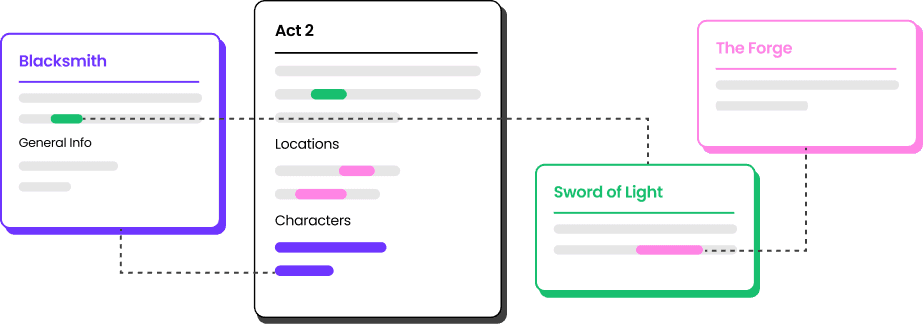
List every object (e.g., “Sword of Light,” “Blacksmith NPC”).
Step 2: Map Relationships
How do they connect? The sword is crafted by the blacksmith, who appears in Act 2, which unlocks the forge location.
So a Weapon is related to a Character, who appears in an Act, which can unlock a Location.
Step 3: Define Flows and Actions
How does a player (or designer) move through this network?
Step 4: Assign Ownership
Who’s responsible for updates? Who’s notified when changes happen?
Step 5: Monitor Health
Are relationships clear? Are updates propagating? Where are the bottlenecks?
Outcome: A living map of your game’s DNA, usable by artists, designers, and engineers.
Getting started
Audit Your Chaos:
Where do breakdowns happen? (Try Grimoire’s Content Ecosystem Canvas.)
The Content Ecosystem Mapping is based on Jill's expertise as a UX designer, workshopper, and game designer.
The framework combines (parts of) other frameworks she has been using for years: design thinking, agile methods, ecosystem mapping, but most of all OOUX.
OOUX or Object-Oriented UX was coined by Sophia Prater. This is our interpretation of how to use it for game development. If you want to learn more, visit her website here.
Next in this series:
The What: Relationship Management Systems in Practice (How RMS tools turn theory into workflows that scale.)